
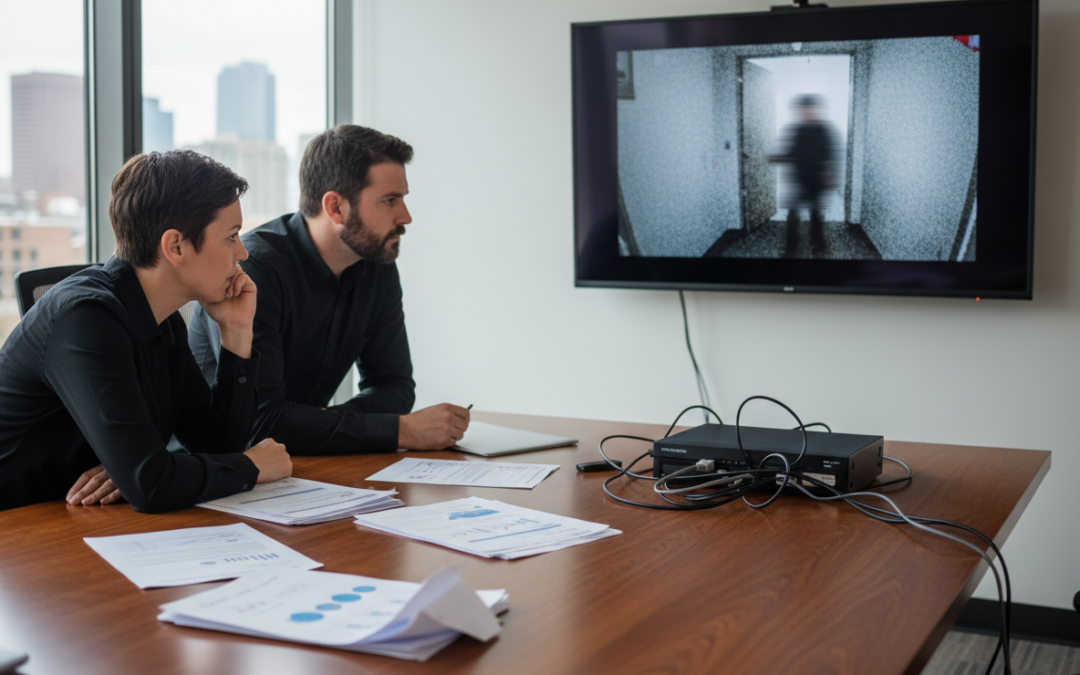
If you’re still running an outdated video surveillance system, you’re probably not thinking about it every day—and that’s exactly the problem. Legacy surveillance tends to fail quietly. It degrades over time, becomes harder to maintain, and slowly stops delivering what you bought it for: visibility, deterrence, and reliable evidence.
You don’t feel the cost until something happens. A theft. A safety incident. A customer dispute. A break-in after hours. Suddenly you’re depending on footage that’s blurry, missing, overwritten, or locked behind a clunky interface no one remembers how to use.
For Denver businesses—especially in commercial construction, multifamily properties, and warehouses—surveillance isn’t a “nice to have.” It’s part of your operational backbone. When it’s outdated, it creates blind spots that ripple into real business costs: higher maintenance, slower investigations, increased liability, and missed opportunities to prevent the next incident.
Let’s break down the hidden costs of an outdated video surveillance system, how they show up in day-to-day operations, and what a modern Cloud VMS can do differently.
1) Operational blind spots you don’t discover until it’s too late
Most legacy systems don’t fail all at once. They fail in pieces:
- A camera goes out intermittently
- Night footage becomes unusable
- Motion recording misses key moments
- Storage fills up faster than expected
- The recorder reboots and no one notices
That creates a dangerous illusion: you think you’re covered because the cameras are physically there. But coverage isn’t the same as visibility.
Operational blind spots are expensive because they delay response. If a warehouse door is being propped open at night, or a construction site is being accessed after hours, you want to know quickly—ideally before losses stack up.
With an outdated video surveillance system, you often find out after the fact, when the footage is needed and the system can’t deliver.
2) Poor image quality turns “video evidence” into guesswork
Aging cameras and older recorders typically mean lower resolution, weaker low-light performance, and compression artifacts that destroy detail. Even if the system is technically recording, the footage may not be usable.
This is where the cost becomes painfully real:
- You can’t identify faces with confidence
- You can’t read license plates
- You can’t confirm whether a tool was taken or moved
- You can’t verify the sequence of events in a slip-and-fall claim
In other words, you have video, but not evidence.
And when evidence is weak, investigations take longer. You spend more staff time reviewing footage. You involve more people. You second-guess decisions. You may even lose disputes you could have won with clear, time-stamped, high-quality video.
Modern surveillance isn’t just about “more pixels.” It’s about clarity where it counts: entrances, loading docks, parking lots, stairwells, and high-risk zones. If your system can’t deliver usable footage in those areas, it’s costing you in ways that don’t show up on an invoice.
3) Downtime and missed recordings create liability exposure
When a camera is down—or recording fails—you don’t just lose visibility. You create a gap in your documentation.
For multifamily properties, that gap can become a tenant safety issue. For construction sites, it can complicate incident reporting and subcontractor accountability. For warehouses, it can turn inventory shrinkage into a recurring mystery.
The hidden cost here is liability:
- You can’t corroborate what happened
- You can’t prove who entered an area
- You can’t show whether safety procedures were followed
- You can’t support an insurance claim as strongly
Legacy systems are more prone to failure because they rely on aging hard drives, outdated firmware, and equipment that’s no longer supported by the manufacturer.
A modern Cloud VMS approach reduces single points of failure and makes system health easier to monitor. If a camera goes offline, you can get alerted. If storage is nearing capacity, you can adjust retention. If a site needs expansion, you can scale without ripping everything out.
4) Higher maintenance costs—and the “support dead end”
One of the most frustrating parts of running an outdated video surveillance system is that the true cost isn’t just repairs. It’s the time spent trying to get it repaired.
Legacy systems often come with:
- Proprietary hardware that’s hard to replace
- Vendor lock-in with limited service options
- End-of-life recorders with no security updates
- Inconsistent compatibility between cameras and NVR/DVR units
So you end up paying in multiple ways:
- Emergency service calls
- Replacement parts that are expensive or backordered
- Temporary workarounds that become permanent
- Staff time coordinating access, troubleshooting, and resets
And when the manufacturer no longer supports the platform, you hit a dead end. You’re stuck maintaining a system that’s getting harder to maintain every year.
Professional support changes the equation. The goal isn’t to sell you “new gear.” It’s to give you a system that can be serviced, monitored, and upgraded without drama.
5) Limited searchability slows investigations and burns staff time
If you’ve ever tried to find a specific moment on an older DVR interface, you already know the pain:
- Scrubbing through hours of footage
- Guessing timestamps
- Exporting clips that fail or take forever
- Jumping camera to camera with no easy correlation
This is one of the biggest hidden costs because it’s a productivity drain. Every investigation becomes a time sink.
And investigations aren’t rare. They happen all the time:
- Package thefts
- Parking lot incidents
- Employee time disputes
- Vendor deliveries
- Safety incidents
- After-hours access
A modern Cloud VMS changes the workflow. Instead of “hunt and hope,” you get faster ways to locate what matters:
- Smarter timeline navigation
- Centralized multi-camera review
- Better exports and sharing
- AI-powered video search (when configured appropriately)
The result is simple: less time searching, faster decisions, and fewer operational disruptions.
6) Cybersecurity risk: older surveillance can be an easy entry point
This is the cost most businesses don’t see coming.
Many older camera systems were designed in an era when “security” meant physical security—not network security. Default passwords, outdated protocols, and unpatched firmware can turn cameras and recorders into vulnerable devices on your network.
That creates risk beyond surveillance:
- Unauthorized access to camera feeds
- Compromised credentials reused elsewhere
- A foothold for attackers to move laterally
- Exposure of tenant or customer privacy
If your surveillance system is connected to your network (and most are), it needs to be treated like any other critical IT asset.
A modern approach includes:
- Secure configuration and credential management
- Network segmentation guidance
- Ongoing firmware and platform updates
- Visibility into device health and access logs
This is where having one provider who understands both physical surveillance and cybersecurity becomes a real advantage. You’re not just installing cameras—you’re managing risk.
7) Expansion becomes expensive when your system can’t scale
Denver businesses grow. Properties add buildings. Warehouses expand. Construction sites change. Tenants come and go.
With an outdated video surveillance system, scaling often means:
- Adding another recorder
- Creating another login
- Managing separate storage pools
- Increasing complexity until no one “owns” the system
Complexity is a cost. It increases mistakes, slows investigations, and makes maintenance harder.
A Cloud VMS is designed to scale more cleanly. You can add cameras, adjust retention, manage users, and standardize your setup across sites—without turning your surveillance into a patchwork.
What modern surveillance looks like: Cloud VMS + professional support
Modernizing doesn’t have to mean ripping out everything you own. In many cases, you can modernize the platform while keeping much of your existing camera infrastructure—especially if you have a mix of models and want a practical path forward.
The goal is to move from “a box in a closet” to a system that’s:
- Easier to manage
- Faster to search
- More reliable
- More secure
- Supported by professionals who can keep it running
A modern Cloud VMS can deliver:
- Centralized management across one or multiple sites
- Better playback and export tools
- Health monitoring and alerts
- AI features like license plate recognition and vehicle surveillance (where appropriate)
- AI-powered video search to reduce investigation time
And professional support matters because technology alone doesn’t solve the problem. The real value is in design, installation quality, and ongoing service:
- Camera placement that actually covers risk areas
- Proper lighting considerations
- Network configuration that doesn’t create vulnerabilities
- Maintenance plans that prevent downtime
A practical next step for Denver businesses: schedule a system review
If you suspect you’re running an outdated video surveillance system, you don’t need to guess. You need a clear assessment.
A system review helps you answer:
- Which cameras are underperforming or failing?
- Are you getting usable footage at night and in key zones?
- How reliable is your recording and retention?
- How long does it take to find and export an incident?
- Is your system creating cybersecurity risk?
- What’s the most cost-effective modernization path?
At Fortify Security, you get a practical, Denver-based partner that understands both commercial video surveillance and cybersecurity. We’ll help you modernize without unnecessary replacements—and build a system you can trust when it matters.
If you’re ready to reduce blind spots, speed up investigations, and stop paying the hidden costs of legacy surveillance, book a surveillance system review with Fortify Security today.